

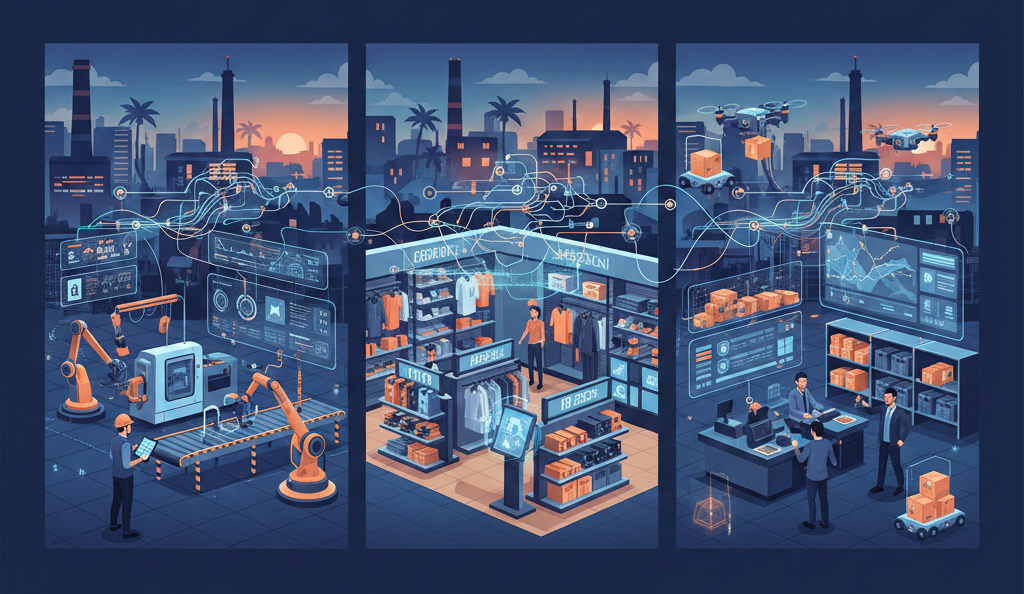
Artificial Intelligence in Pakistani SMEs
What if the real threat to Pakistan’s SMEs isn’t rising costs, energy shortages, or global competition—but the decision to do nothing about AI and IoT?
That question makes many business owners uncomfortable. And it should.
Across Pakistan, small and medium enterprises (SMEs) form the backbone of the economy—manufacturing units in Sialkot, textile workshops in Faisalabad, retail chains in Lahore, cold storage facilities, clinics, schools, and logistics startups. Yet most of them are operating with minimal data, manual decision-making, and reactive processes. In a world rapidly moving toward intelligence-driven automation, this gap is no longer sustainable.
The AIoT Moment We’re Missing
Artificial Intelligence (AI) and the Internet of Things (IoT) are no longer futuristic buzzwords. Globally, they are already shaping how businesses predict demand, optimize energy usage, prevent machine failures, and personalize customer experiences.
But here’s the uncomfortable truth:
Most Pakistani SMEs believe AI and IoT are either too expensive, too complex, or simply “not for us.”
That belief is quietly costing them competitiveness.
IoT generates data—machine performance, temperature, energy consumption, footfall, inventory movement. AI turns that raw data into insight—when to service a machine, why energy bills are spiking, which product will run out next week, or where losses are happening silently.
Separately, AI and IoT are useful.
Together—as AIoT—they become transformational.
So why hasn’t adoption taken off in Pakistan’s SME sector?
The Real Barriers (And They’re Not What You Think)
The problem isn’t lack of ambition. Pakistani entrepreneurs are resilient and innovative by necessity. The real barriers are:
- Fragmented solutions: One vendor for sensors, another for dashboards, another for analytics—nothing talks to each other.
- High upfront costs: Imported platforms priced for enterprises, not SMEs.
- Lack of local context: Solutions that ignore load shedding, unstable connectivity, or on-ground operational realities.
- No actionable intelligence: Data is collected, but decisions are still made on gut feeling.
This leads to a dangerous outcome: businesses install “smart” devices but remain operationally blind.
And that brings us back to the core question:
If AI and IoT are so powerful, why aren’t they actually helping SMEs make better decisions—today?
Where Think Connects Changes the Equation
This is exactly the gap Think Connects AIoT platform was built to solve.
Instead of forcing SMEs to adapt to technology, Think Connects adapts technology to SMEs.
The platform doesn’t treat AI and IoT as separate layers. It treats them as one intelligence loop—sense, analyze, decide, act—designed specifically for Pakistani business realities.
What makes it different?
- Unified AIoT platform: Sensors, data ingestion, AI models, and dashboards—all in one ecosystem.
- SME-first design: Scalable, modular, and cost-aware. You start small and grow.
- Local intelligence: Models trained to understand local patterns—energy usage, operational downtime, seasonal behavior.
- Decision-focused AI: Not just graphs, but recommendations—what to fix, when to act, where to save.
In other words, Think Connects doesn’t ask, “How smart is your hardware?”
It asks, “How smart are your decisions?”
AIoT as a Survival Strategy, Not a Luxury
For SMEs, AIoT is no longer about innovation awards or fancy dashboards. It’s about survival.
- Can you detect faults before a machine fails?
- Can you reduce energy waste in a high-tariff environment?
- Can you scale operations without scaling chaos?
- Can you compete with data-driven players using intuition alone?
The SMEs that will thrive in the next decade won’t be the biggest—they’ll be the smartest.
And smart doesn’t mean complex. It means connected intelligence, deployed with purpose.
So, What’s the Answer?
If Pakistan’s SMEs are to truly adopt AI and IoT—not as experiments, but as operational tools—they need more than technology. They need a platform that understands them.
That’s the question this blog leaves you with:
Is AIoT just another trend we talk about—or is it the missing layer between hard work and sustainable growth?
The answer isn’t theoretical.
It’s practical.
It’s local.
And it’s already being built.
Explore how Think Connects’ AIoT platform is redefining what AI and IoT mean for Pakistan’s SMEs—and decide for yourself whether this is the future your business can afford to ignore.
GET STARTED FREE
30 Day Free Trial
No credit card required